




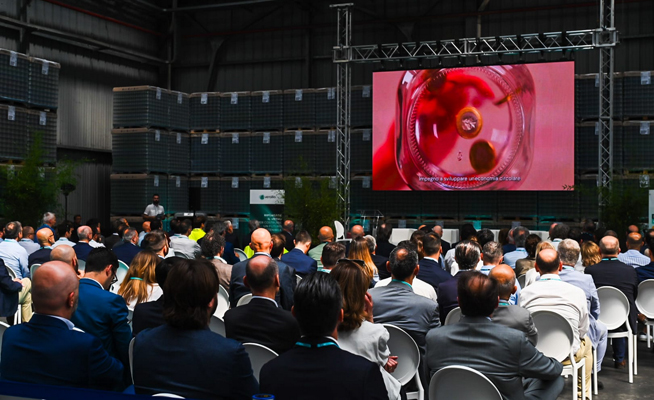
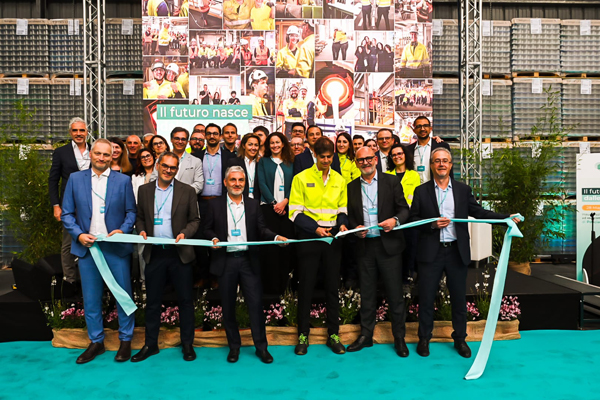
The inauguration of Verallia’s new oxy-fuel furnace took place May 28 in Pescia, in the province of Pistoia, Tuscany. Verallia is the European leader and the world’s third-largest producer of glass packaging for beverages and food products. The event marks a tangible milestone in the industrial modernisation of the Tuscan site—in operation since 1976 and today among the most advanced in the Group—backed by an investment of approximately EUR 110 million, new jobs and a significant leap forward in environmental sustainability.
The new facility is housed in a brand new building constructed where a storage area once stood. With the new furnace, production at the Pescia plant has more than doubled, going from three to seven production lines.
The entire facility was designed in-house by Verallia. Suppliers for the new lines include Air Liquide, Bottero, Antonini, R. Cestaro, All Glass, Iris Inspection, Tiama and Thimon among others.
With 7 glass plants, 14 furnaces, 3 cullet (glassware) processing centres and 3 silica sand extraction and processing plants, 1,745 employees (20% women, women are also 40% of the managers), Verallia Italia is the leading Italian producers of glass packaging.
The cullet recycling centres are managed by Ecoglass while the silica sand plants are managed by Silver srl and both companies are owned by Verallia Italia.
Verallia Italia has also created a sales network and a dedicated division, Verallia Distribution, with 20 agents in the area, 5 dedicated warehouses and more than 2,000 customers served.
The event featured addresses from Verallia Group CEO Patrice Lucas, Verallia Italia CEO Marco Ravasi, Verallia Italia Industrial Director Andrea Maffei and the Director of the Verallia Pescia plant, Mattia Papini, and local authorities.
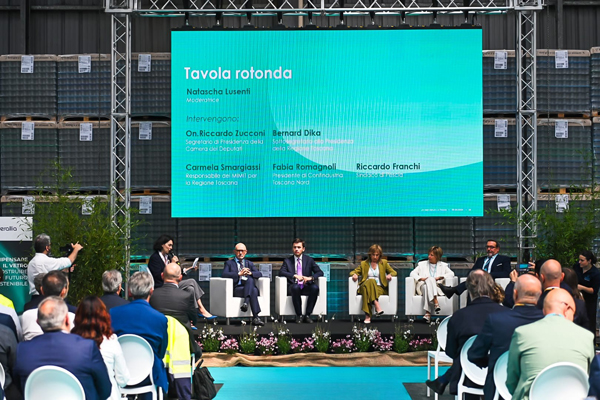
This was followed by an institutional round table, moderated by journalist Natascha Lusenti, which brought together Riccardo Zucconi, Secretary of the Presidency and FdI Energy Spokesperson at the Chamber of Deputies; Bernard Dika, Undersecretary to the Presidency of the Tuscany Region; Carmela Smargiassi, MIMIT Representative for the Tuscany Region; Fabia Romagnoli, President of President of the Confederation of North Tuscany; and Riccardo Franchi, Mayor of Pescia—confirming the strategic value this investment holds for the local area, for the competitiveness of Made in Italy and for the Italian glass supply chain.
The project will have a significant impact on local employment: the new furnace has enabled the recruitment of around one hundred people, with a tangible effect on the local area in terms of employment, inclusion and social cohesion. At the plant, 20% of staff are women, figures that align with Verallia Italia’s journey towards gender parity, certified under UNI/PdR 125:2022 since 2023.
“This plant is not just a production facility: it is an opportunity for growth in Pescia and an important step on the road to a more sustainable glass supply chain, one that adds value to the material collected locally by turning it into a resource,” said Riccardo Zucconi, Secretary of the Presidency and FdI Energy Spokesperson at the Chamber of Deputies. “Its operations will create direct jobs, from technicians to plant operators, and will stimulate demand for local services and supplies, supporting the wider economy and small businesses in the area. At the same time, it can become a driver of innovation, attracting investment and fostering partnerships with technical and research bodies interested in developing low-impact processes. The new furnace represents a real opportunity for sustainable development, capable of generating jobs, making the most of local resources and promoting a culture of recycling and innovation.”
The investment has also had a positive impact on local businesses, involving more than 100 local suppliers who are partners of Verallia Italia.
“Verallia Italia is an example of how a major industrial group can put down roots in a region and become an integral part of it,” said Bernard Dika, Undersecretary to the Presidency of the Tuscany Region. “Investing, hiring, training and creating the conditions for people to grow means building the future. Young people stay where they find technology, skills and a working environment that values them, and Verallia at Pescia shows that modern manufacturing can be attractive to the next generation. It is an important signal: we need companies that invest in people with the same ambition with which they invest in technology.”
“Verallia Italia is part of Pescia and today, with this inauguration, it confirms a bond that goes well beyond production. One hundred new hires, a substantial investment, care for the environment and for people: these are concrete facts that strengthen the industrial identity of our town. We are proud to host a plant that has become a point of reference for the whole area,” said Riccardo Franchi, Mayor of Pescia.
HeatOx™ technology: a generational leap in glass melting
With the new furnace, Verallia Italia has adopted HeatOx™ technology from Air Liquide: an optimised oxy-fuel combustion solution that replaces the air fed into the furnace with oxygen, improving melting efficiency and reducing pollutant emissions. The residual heat is recovered to warm industrial spaces, eliminating the need for natural-gas boilers.
This is a tangible contribution to the Group’s Net Zero pathway, committed to a 90% reduction in scope 1 and 2 emissions by 2040, validated by SBTi and aligned with the Paris Agreement, delivering 12% less fossil fuel use and 7.8 fewer kilotonnes of CO2 per year.
Verallia Italia uses on average 63.9% recycled glass (2025 Verallia Italia data, external cullet). Tuscany is a national benchmark with a 96.5% glass recycling rate, compared with Italy’s 80.3%, already well above the European target of 70% by 2030. Because for Verallia, sustainability also means building value for people and communities, bottle after bottle.
“With this very significant investment, Verallia Italia takes a further step forward in introducing advanced technologies that also reduce the environmental impact of production processes, in line with the path taken by the manufacturing industries of the area, of which Verallia is one of the most notable examples,” said Fabia Romagnoli, President of the Confederation of North Tuscany. “I also see the way the company has managed this transition very positively, engaging the wider community and providing thorough information and explanations about the effects of the investment. The results are clear and open up horizons for the company in directions that would have been unthinkable only yesterday: plants this modern require specialist staff whose strength lies purely in technical expertise, making gender barriers, for example, obsolete. This is what manufacturing looks like today: a modern macro-sector that incorporates ‘intelligent’ technologies. What we have seen today demonstrates this clearly.”
Verallia Italia for Made In Italy: serving food & beverages
The new furnace at Pescia is dedicated to the production of flint glass: a strategic choice that allows a single plant to serve a broad range of markets: wine, oil, preserves, spirits and soft drinks, with varying shapes and formats. For food & beverage customers, this means greater product availability, continuity of supply and guaranteed quality, in a container made using lower-impact technologies.
In 2025 in Italy 11.4 billion glass bottles and jars were produced (+1,4% vs. 2024), more than 3 billion by Verallia Italia.
“The Italian agri-food supply chain is a pillar of Made in Italy, recognised worldwide for its quality, innovation and roots in the local area,” said Carmela Smargiassi, MIMIT representative for Tuscany. “It is an ecosystem that brings together agricultural production, processing, logistics and distribution, valuing biodiversity and local traditions. The sector is a central element of the national cultural identity and of food well-being. The UNESCO recognition of Italian Cuisine reinforces a model founded on sustainability and the fight against waste. In 2025, according to the OECD, Italy is the world’s fourth-largest exporter, confirming the competitiveness of its production system. In this context packaging is strategic for food & beverage, and companies such as Verallia Italia are making a strong contribution to innovation and the circular economy.”
With this investment, Verallia Italia reinforces its role as a strategic partner for Italian food & beverage producers who export Made in Italy around the world. Glass is an integral part of the product and of its identity: it protects it, enhances it and communicates its quality. Against a backdrop in which Italian agri-food exports reached EUR 60.9 billion in 2025 (+4.5% on 2024, source: SACE Report, Focus ON-Food), investing in production capacity and sustainability means giving concrete support to the competitiveness of the Italian supply chain.
“Developing the market for our customers and championing Made in Italy are at the heart of our strategy,” said Marco Ravasi, CEO of Verallia Italia. “The inauguration of the new furnace fits squarely within this approach: an investment designed to bring us even closer to our customers and to support the growth of the Italian food & beverage sector. This milestone represents not only an important industrial step, but also a moment of development for the entire Tuscan community. Made possible by a shared commitment, it helps to strengthen an increasingly sustainable production model and the role of glass in the development of a circular economy.”