




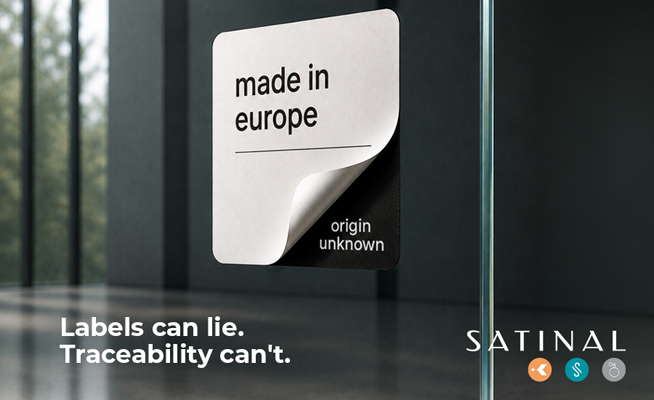
Following its first-hand expose on the disparity between European and Asian manufacturing standards, Satinal drives the conversation forward, calling for institutional transparency, stricter audits, and an industry-wide awakening.
Recently, Satinal shed light on an uncomfortable truth that many in the glass industry prefer to ignore: the heavy reliance of several European distributors on cheap Asian imports. This practice does not just undercut local manufacturers, it active exploits a regulatory vacuum, utilising supply chains where labour conditions and environmental safeguards fall below Western standards.
The debate surrounding corporate social responsibility and fair competition in the glass architecture sector has reached a boiling point. The question is no longer just about where a product is made, but what we risk by continuing to turn a blind eye.
Certain European entities continue to use clever branding cues to mask the true origin of their interlayers. By blending imported raw materials or finished films with local logistics, they present a façade of European quality.
However, as architectural requirements become more stringent, this lack of clarity poses a severe structural and legal liability for façade engineers, builders, and glass processors. A cheaper interlayer might reduce immediate production costs, but it inherits massive ethical and structural risks. When an interlayer lacks verifiable tracking, how can a project manager guarantee its long-term performance under extreme weather conditions, or ensure it will not delaminate due to unverified chemical formulations?
Heavily regulated sectors, most notably the solar energy industry, have already established strict traceability protocols. In solar, leading global companies audit every step of their supply chain to enforce human rights, worker safety and carbon footprint limits.
Satinal firmly believes that the architectural glass sector must implement the same commitment to occupational health, safety and quality. If a solar panel must prove its ethical sourcing to be installed on a public building, the safety glass holding up an entire building façade must be held to the exact same standard.
Satinal’s STRATO® interlayers continue to demonstrate what true European excellence looks like in practice. This means operating an Italian factory and machinery that comply with rigorous safety regulations, while manufacturing products that respect strict local and ethical standards. Furthermore, our processes are regularly verified by external inspectors and authorities to renew product certifications and guarantee total accountability.
Through a dedicated European supply chain forged over a decade with premier international chemical companies, STRATO® comes with a unique tracking code and a specialised anti-counterfeiting hologram. Indeed, the Environmental Product Declaration (EPD) provides verified, “cradle-to-gate” data.
Moreover, operating 100% in Italy under strict ISO 9001 regulations means that every STRATO® product is produced by workers protected by rigorous health and safety laws, which is in contrast with unclassifiable safety conditions of overseas hubs.
The integrity of the European economy depends on fair competition. European producers invest heavily in bureaucratic compliance, green energy transition, and occupational safety. Allowing unverified, cheap imports to be sold locally as equivalent products undermines the investments and punishes companies that choose to do the right thing.
The shift toward ethical sourcing is no longer a future projection.
Serious, forward-thinking professionals are beginning to realise that saving a few cents per square meter on an interlayer is a compromise on quality, human dignity, and safety.
Satinal will continue to lead this charge, proving that true quality cannot exist without ethics. The glass industry must now decide which side of history it wants to stand on.