




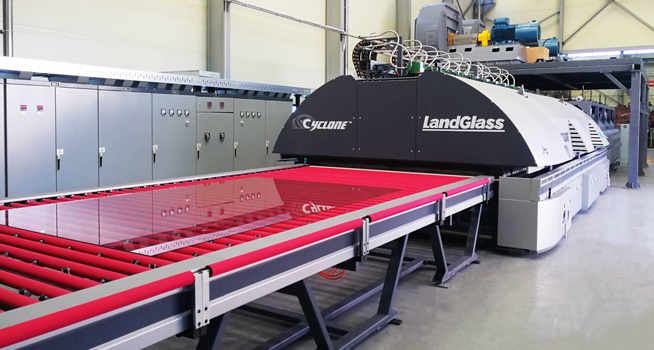
In glass tempering production, “white haze” is a common surface quality defect. It presents itself as microscopic scratches or cloudy marks on the tempered glass surface, appearing in various forms: longitudinal white stripes in the centre, transverse haze marks at both ends, hazy areas near the corners, or equally spaced, repetitive streaks.
Fundamentally, white haze is caused by excessive mechanical friction between the glass—while in its high-temperature, softened state—and the ceramic rollers of the tempering furnace.
The specific root causes involve multiple variables, including equipment precision, heating temperatures and process operations. Drawing upon extensive production experience, LandGlass has systematically analysed the three core causes of white haze along with their corresponding troubleshooting methods for industry reference. As the second article in this series, this piece focuses on oscillation speed—the most easily overlooked processing parameter.
Among various contributing factors, oscillation speed is a parameter that is frequently underestimated. If the oscillation speed is set too high while the glass oscillates within the high-temperature zone, both the frequency and intensity of relative sliding between the lower surface of the glass and the roller conveyor will increase. This is particularly critical when the glass has softened. Excessive oscillation speed significantly exacerbates friction, leaving behind linear or band-like white haze on the glass surface.
It is recommended to configure an appropriate oscillation speed based on glass thickness and format size to ensure smooth movement inside the furnace, preventing friction from intensifying due to over-speeding. For instance, thin glass (3 to 6 millimetres) softens rapidly, requiring a reduced oscillation speed; conversely, thick glass (10 millimetres and above) absorbs heat more slowly, allowing for a slight increase in speed.
Additionally, properly controlling the furnace entry conveyor speed and the loading rate is vital. The entry speed should be neither too fast nor too slow; furthermore, reducing the loading area to minimise thermal accumulation between the sheets can effectively alleviate friction-induced surface whitening.
Taken together, it is evident that white haze is rarely driven by a single root cause, but is rather the result of multiple intertwined factors. Therefore, when addressing white haze issues in actual production, the most effective approach is to adopt a systematic troubleshooting protocol: sequentially audit the mechanical precision of the ceramic rollers (drive synchronisation, radial run-out and levelling), the heating temperature control (top-to-bottom temperature differentials and localised overheating) and the oscillation speed of the glass inside the heating furnace.
Only change one variable at a time and maintain meticulous records, comparing the effects before and after each adjustment to isolate the true root cause. Only through this disciplined approach can white haze be consistently eliminated over the long term, ultimately elevating the surface quality of tempered glass.