


Schiatti Angelo has been designing and manufacturing glass processing machinery since 1969, in Seregno, near Milan, Italy. Sixty years of activity have given the company a privileged viewpoint on what determines the durability and reliability of a machine over time.
When evaluating the purchase of glass processing machinery, the list price is the first number that catches the eye. But there are at least two costs that rarely appear in quotes yet weigh heavily on the economic assessment of the investment: electronic obsolescence and machine downtime.
Electronic obsolescence
Today many machines, produced in different parts of the world, are equivalent in terms of electronic equipment. But sometimes the electronic parts used are designed to age quickly: components out of production, no longer supported software, unavailable control boards. A mechanically “healthy” machine can become unusable because it is no longer updateable. The question to ask: does the manufacturer design its machinery to allow updates over time?
Machine downtime
There is a physiological downtime, one that can be solved quickly with available spare parts and reachable technicians. Different is the downtime that drags on: stopped production, slipping deliveries, waiting customers. The calculation is simple: hourly cost of downtime = daily turnover divided by worked hours, plus the cost of the unactive operator, plus any penalties. Even a few hours of stop can translate into thousands of euros in lost production.
Where reliability is decided
The difference lies in the mechanics: rigid structures, tight tolerances, oversized components where needed. These are the factors that keep a machine efficiently running after thousands of hours of operation and reduce the likelihood of unplanned downtime.
A 15-year comparison
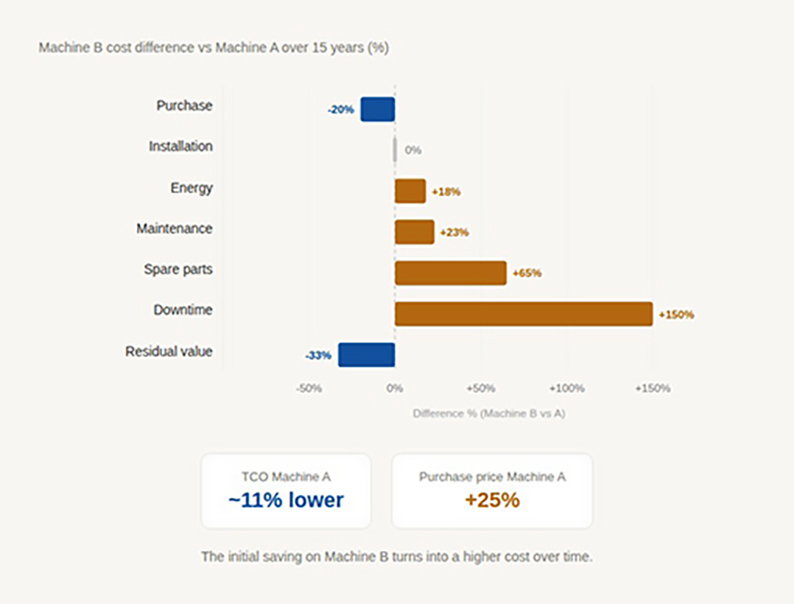
We compared two hypothetical purchasing scenarios for a straight-line edger over a 15-year horizon. Machine A costs 25% more at purchase, but accumulates lower operating costs on energy, maintenance, spare parts and downtime. At the end of the cycle, the total cost of ownership (TCO) of machine A is significantly lower — and its residual value is almost doubled. The initial saving on machine B has turned into a higher cost.
Questions to ask
What is the model’s reliability track record? Are critical spare parts available? Is the machine designed to be serviced and upgraded, or will it need replacement in ten years? A machine built to last requires less maintenance, maintains its efficiency longer and stays operational when it matters.