




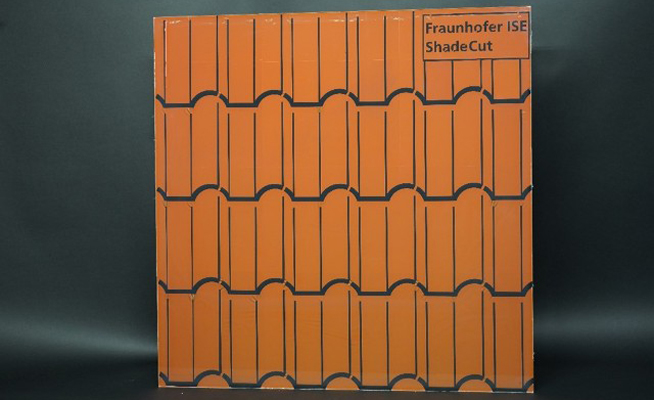
Scientists at the Fraunhofer Institute for Solar Energy Systems ISE have succeeded in creating coloured films with transparent cutouts, thereby producing realistic-looking designs on photovoltaic modules. In this way, roof tiles, for example, can be imitated.
The film cutout patterns utilise MorphoColor® technology, an invention of Fraunhofer ISE that creates a colour impression without significantly impairing the efficiency of a PV module. Visitors to The Smarter E / Intersolar 2026 can view PV modules equipped with “ShadeCut” at the Fraunhofer ISE booth A1.440.
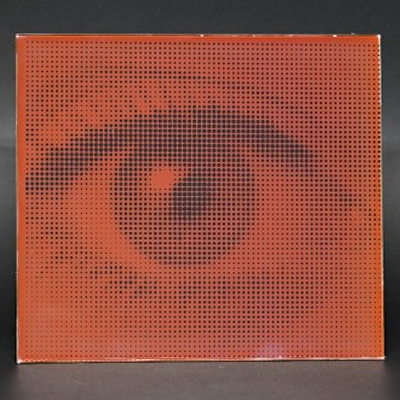
“Through targeted structuring and cutouts on a colour-producing film, we can integrate colour effects and complex patterns directly into solar modules and facade elements,” explains Marco Ernst, developer of the “ShadeCut” technology and a researcher at Fraunhofer ISE. “Additionally, there is the option to add further layers with cutouts to create structures or additional colours.”
The technology can be applied to all standard photovoltaic and solar thermal modules; the desired pattern is cut into the films with MorphoColor® coating using laser or CAD-controlled processes.
“The technology is particularly interesting for modules intended for integration into facades, roof-integrated PV, or even railings—especially on historic buildings,” said Dr. Martin Heinrich, group leader for encapsulation and integration of photovoltaics at Fraunhofer ISE. “Modules with ShadeCut can look like masonry or roof tiles and blend in perfectly in terms of colour. It also allows for the customisation of PV systems, for example with logo lettering or patterns.”
The MorphoColor® technology for colour is inspired by the butterfly of the same name. The 3D photonic structures on the butterfly’s wings create an intense and angle-stable colour impression through a fundamentally low-loss interference effect. Following this biological model, a research team at Fraunhofer ISE has succeeded in applying a similar surface structure to the back of the cover glass of photovoltaic modules using a vacuum process.
Depending on the microstructure, cover glasses can thus be produced in various colours. Scientists have now also succeeded in applying this to film, either as a flexible encapsulation film in modules or as a back-sheet. Independent measurements confirm that the coloured PV modules with MorphoColor® coating deliver approximately 95 percent of the power output of a comparable uncoated module.