


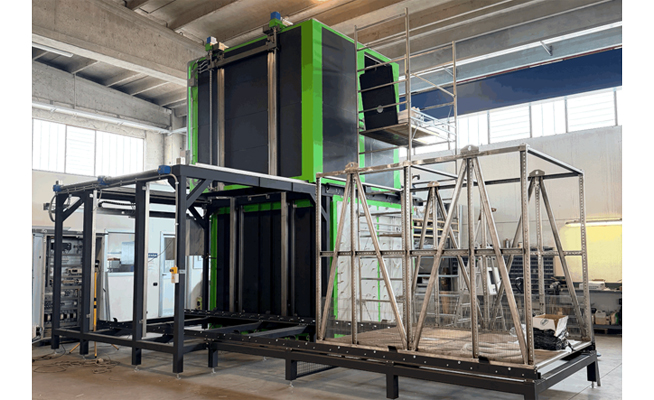
There is a countdown for RCN Solutions’ chemical tempering plant in construction: delivery is expected by mid-March to an Italian company having NDA projects for the naval industry.
In a customised active size of 2,500 by 2,000 millimetres, this machine is part of a more structured production layout the Italian company is carrying out.
The chemical tempering process is more and more demanded because it grants superior strength with no anisotropy, in addition to the tempering of very thin glass to be used in special glass assemblies where light weight and safety should be combined.
The role of the chemical tempering is becoming more and more crucial since the process does not deform glass and it is preferable for electronic devices, optical and precision glass, complex shapes or curves in different sizes and thicknesses They are in demand within the automotive and naval industry, among many others.
Chemically tempered glass has a high mechanical resistance, 6 to 8 times over normal glass, and offers better resistance to thermal shock and high temperatures. These are few of the reasons that makes it preferable for some high-profile applications.
The process is totally different than the popular thermal one: it has no fast quenching, no roll wave to provoke distortion, and the result is a uniform stress profile. It is based on ion exchange between glass and potassium salts that creates a uniform compression load on the glass surface rather than an uneven stressed one.
Born in 2017, RCN’s CT line has satisfied international companies such as AGC and Schott, but this system is also suitable for small or medium size companies who want to invest in new generation products.
The recent trend of glass manufacturers focusing their production on thin glass to lighten glass assemblies shows a market looking for new technologies and solutions.
From small to big sizes, RCN is in the position to satisfy all these demands for machines. It is enough to contact the company and explain your projects.