


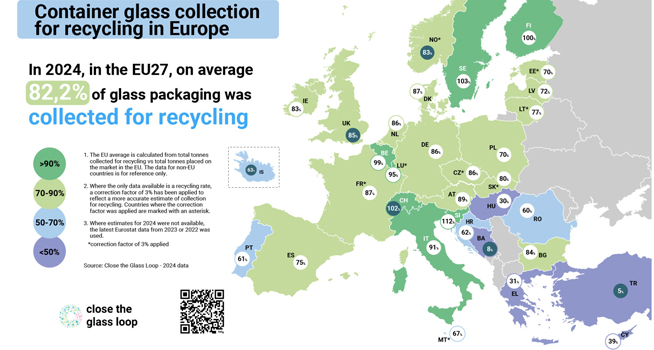
The latest data recently released by Close the Glass Loop shows a record performance for glass packaging collection for recycling across the EU, reaching a rate of 82,2%1 in 2024.
This performance underlines the efficiency and effectiveness of separate collection systems across Europe, especially when considering that 87% of all collected glass packaging is sourced from municipal waste management.
“Local authorities are not only responsible for municipal waste management, they are securing the supply of secondary raw materials into the circular economy and glass packaging is a strong example of this”, highlighted Françoise Bonnet, Secretary General of ACR+, the Association of Cities and Regions for Sustainable Resource Management. “To close the collection gap, we need to reinforce the partnership between municipalities and industrial value chains, to boost collection and recycling rates, and, in the end, strengthen the environmental and economic benefits delivered to citizens.”
While the overall progress of the EU collection for recycling rate is encouraging, there is still a big disparity between EU Member States that must be addressed. Further efforts will be needed on national level to achieve Close the Glass Loop’s ambition of reaching a 90% collection for recycling rate by 2030.
“Since the beginning, Close the Glass Loop has recognised the critical role of national value chains, through the development of its national platforms”, added Carlo Pirrone, Secretary General of FEVE – the European Container Glass Federation. “Glass can be reused and is endlessly recyclable, no matter where it is consumed. The next phase of our work should focus on strengthening capacity on the ground, targeting investment where it can deliver the greatest impact and accelerating progress in countries that still have the largest collection gaps.”
Progress on collection must also go hand in hand with progress on recycling, to ensure that glass containers are transformed back into glass containers. “Investments in glass cullet recycling facilities have enabled a circular model for glass, where it is estimated that 85% of all glass packaging collected is effectively recycled in a closed loop”, stressed Rene Schroeder, Secretary General of FERVER – the European Glass Recyclers’ Federation. “While increasing collection volumes is key, it must be accompanied by a strong focus on collection quality and recyclability of the glass packaging, to maximise the amount of glass that can be recycled back into new containers.”
Such efforts will be carried out on the basis of the design-for-recycling criteria prepared by the CEN (European Committee for Standardisation), in view of the implementation of the Packaging & Packaging Waste Regulation.