





Beatson Clark’s amber glass is type III pharmaceutical glass manufactured in line with the US and EU pharmacopeia standards, which means glass must not allow more than 10 percent light transmission between 290nm and 450nm.
Beatson Clark recently made its amber glass even darker to provide more protection against the effects of light strike, while also giving the bottles a richer, premium appearance that stands out on the shelf.
Putting amber glass to the test
Beatson Clark wanted to put its amber glass to the test, so the company decided to carry out a full spectrum analysis of light transmission. They took a competitor’s standard 500ml imported amber glass bottle and tested it against a comparable 500ml beer bottle produced by Beatson Clark.
The findings revealed that the imported glass allows more light to pass through in the critical range, offering less protection against light strike than Beatson Clark’s bottle. On the graph below, the blue line represents the imported bottle, while the orange line represents the Beatson Clark bottle.
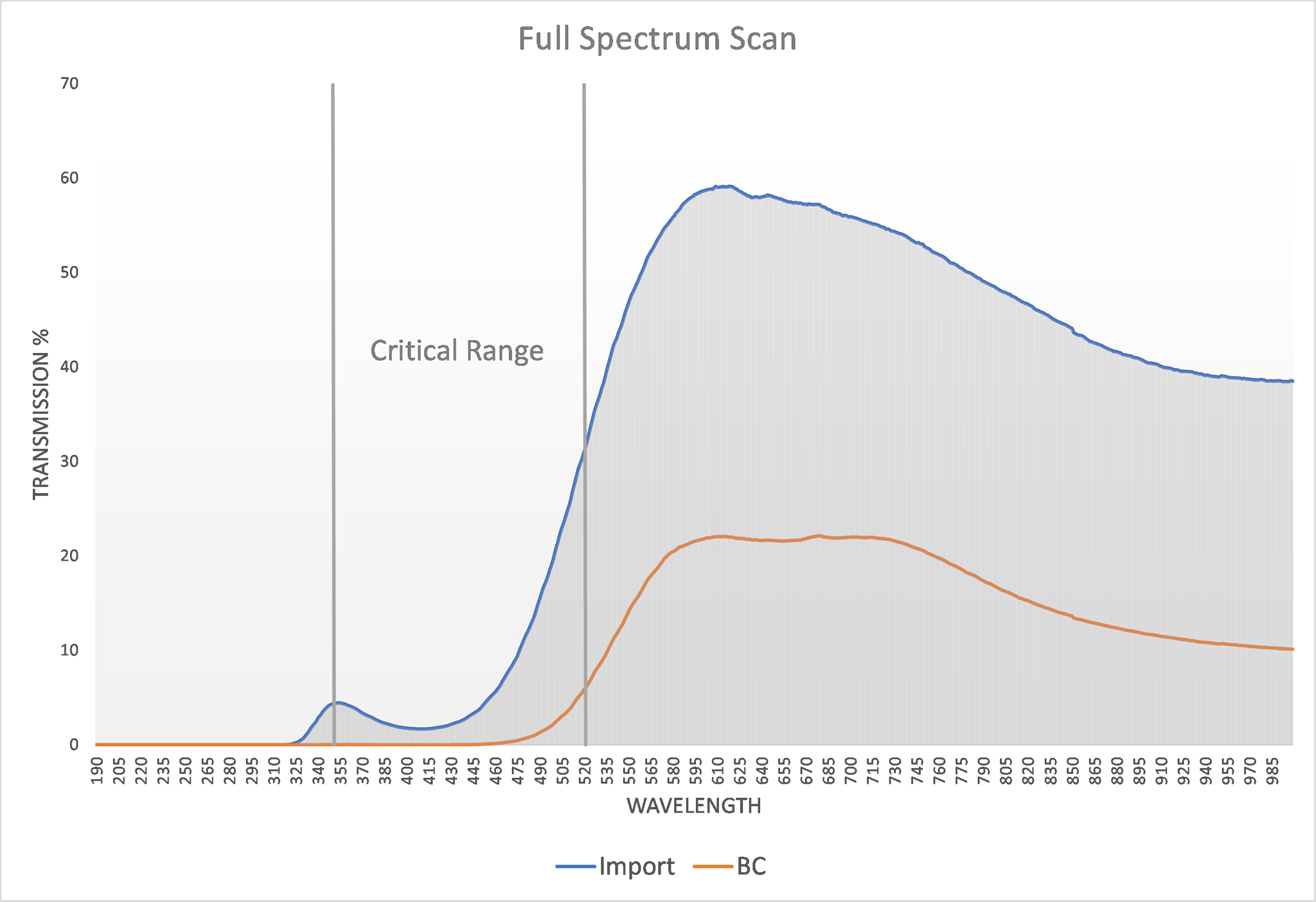
While transmission values can vary slightly between different container shapes and sizes, the darker amber typically achieves levels well below this limit and will never exceed the 10 percent threshold.
So, if you want to protect your beer and keep it in tip top condition, Beatson Clark’s amber glass bottles are the recommended choice!
Amber glass for the pharmaceutical industry
Amber glass isn’t just important for preserving the flavour of beer. It also plays a key role in the pharmaceutical industry. Many medicines are sensitive to light, and exposure to UV rays or certain wavelengths of visible light can gradually reduce their strength and effectiveness.
By filtering out these harmful wavelengths, amber glass helps to maintain the stability and reliability of light-sensitive products throughout their shelf life.
With Beatson Clark’s darker amber glass, pharmaceutical manufacturers can be confident that their products are packaged in containers that meet strict pharmacopoeia standards while also helping to safeguard patient safety.