




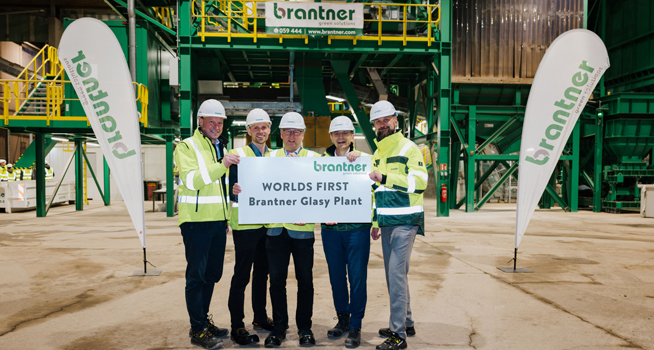
Brantner green solutions, supported by Stoelzle, has developed the “Glasy” recycling technology which recovers glass from residual waste incineration residues with a purity of 99.9999 percent; the first industrial system is already operating and supplies high-quality cullet for glass production.
Residual waste incineration generates large quantities of residues that still contain up to 30 percent glass. To date, however, sorting technologies have not been sufficient to process the separated glass in such a way that it can be used by the glass industry as a high-quality secondary raw material. Thanks to an upstream thermal treatment step Glasy provides cullet which is almost free from contamination.
Stoelzle was closely involved in the development of Glasy. In their in-house glass laboratory at Stoelzle Oberglas, the recovered cullet was analysed and tested in lab-scale melts to confirm that it can be safely used in the production of premium glass. From a technological perspective, the Brantner process includes an integrated advance sampling taken directly from the product stream of the sorting system, combined with AI-based evaluation of the achieved quality the properties of the recovered product are determined almost in real time. For Stoelzle as a glass manufacturer, this means seamless traceability of cullet quality. The system is so far unique and Brantner green solutions has also filed a patent application for it.
“As a manufacturer of premium glass packaging, we depend on a consistently available supply of extremely pure cullet,” said Dr. August Grupp, CEO of Stoelzle. “Using recycled glass in the batch saves raw materials, energy and CO2 emissions and Glasy allows us to use glass from waste incineration residues as a secondary raw material on an industrial scale – another step towards a truly circular economy.”
Thanks to the innovative Glasy technology, around 20,000 tonnes of glass can be recovered from waste incineration residues in Austria every year and made available to the glass industry as a high-quality secondary raw material.
For every ton of cullet used at Stoelzle, around 1,200 kilograms of primary raw materials can be saved. Using cullet avoids the release of around 200 kilograms of CO2 that is bound in this quantity in primary raw materials. Furthermore, each 10 percent of cullet share in the overall batch reduces the energy required for melting by around 2 to 3 percent.