




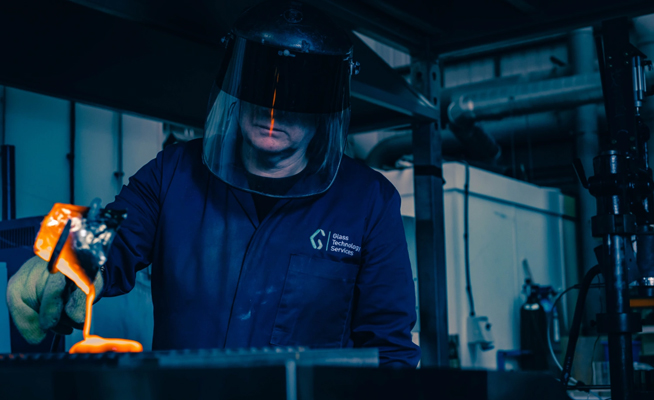
Glass Technology Services (GTS) has successfully completed the construction and commissioning of its new large-scale research furnace at its Sheffield laboratory facility. The completion marks a major expansion of its capabilities in glass melting and materials innovation.
GTS has been carrying out world-leading research in both mainstream and specialist glass fields for over a hundred years, but until now, glass melting trials have been limited to batches of a maximum of 2 kilograms per melt.
The newly commissioned furnace increases this capacity, enabling melts of up to 50 kilograms, providing a greater representative scale for research trials and pre-commercial development.
The development of its High Temperature Melting Observation System (HTMOS) is a unique melting facility designed to GTS’s own specification by A.F.T (UK) with a range of bespoke components to enable better glass observation, measurement and control.
“This investment represents a significant evolution in our research capability,” said GTS Chief Executive Gareth Jones. “By bridging the gap between small-scale laboratory melts and industrial production, we can offer our partners and clients deeper insight, greater confidence, and a faster route to innovation.”
GTS’s larger melting capacity will alongside existing melting capabilities enabling staged glass trials to validate findings from small-scale melts. The furnace is equipped with an expanded suite of analytical tools that transform GTS’s ability to observe and quantify melting behaviour:
- Gravimetric monitoring to track mass changes and material evolution throughout the melt.
- In furnace camera systems to visually record melting progression and batch reactions at temperature throughout the melting cycle.
- Offgas analysis, enabling real-time monitoring of gases released during melting and refining.
- Sampling during melting, allowing intermediate assessment of seed, refining, and batch free times.
- Stirring and Viscometry, in melt provision of a physical stirrer and indictive viscosity measurement as the melt progresses
The new furnace also enables melting up to 1,600 degrees Celsius, opening pathways for the development of new glass compositions, including advanced and high temperature formulations.