



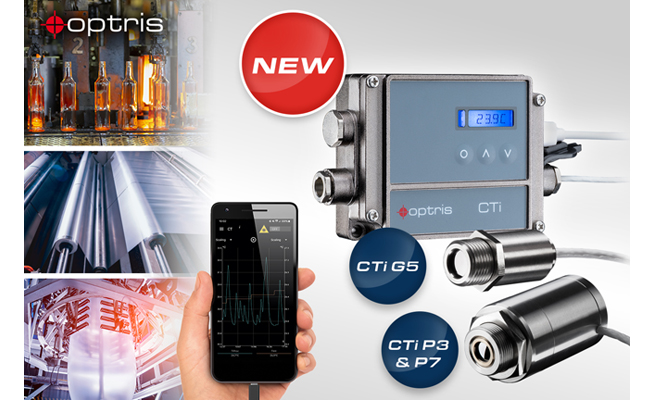
Optris continues to expand its successful CTi infrared pyrometer platform with the introduction of three new models: CTi G5, CTi P3 and CTi P7. Designed for highly specialised industrial processes, the new additions extend the CTi portfolio with dedicated solutions for glass manufacturing and thin-film plastic production..
With optimised spectral ranges, fast response times, and extensive interface options, such as the built-in USB interface the new pyrometers enable precise and reliable non-contact temperature measurement across a wide variety of applications.
CTi G5: Accurate temperature measurement for glass applications
The CTi G5 has been specifically developed for demanding glass manufacturing processes such as container glass, flat glass, automotive glass and photovoltaic production. Operating at a spectral range of 5.0 µm, the sensor achieves high emissivity stability and reliable measurements across temperatures from 50 °C up to 1650 °C, depending on the model version. Its fast response time down to 70 ms and measurement uncertainty of ±(1% of reading +1.5 °C) ensure dependable process control even in dynamic production environments.
The compact stainless-steel sensing head withstands ambient temperatures up to 85 °C without additional cooling, while the proven two-piece design with integrated display and programming keys enables easy setup and maintenance. Multiple analogue and digital interfaces allow seamless integration into modern automation systems.
CTi P3 and CTi P7: Optimised for thin plastic films
With the CTi P3 and CTi P7, Optris introduces two highly specialised pyrometers for accurate measurement of thin plastic materials. The CTi P3 operates at a narrow spectral wavelength of 3.43 µm and measures temperatures from 35 °C to 600 °C with extremely fast response times of just 15 ms, making it ideal for high-speed film production lines.
The CTi P7 complements the portfolio with a 7.9 µm spectral range designed for material-specific absorption bands, enabling reliable measurement of thin films such as PET, PVC, or polyimide from 0 °C to 710 °C. With a typical NETD of 45 mK and robust IP65 design, it ensures stable operation in industrial environments. Both models feature adjustable emissivity settings, extensive signal processing functions, and flexible industrial communication interfaces, supporting precise process monitoring and quality assurance.